Voice Agents (AWS)
Automated Outbound Telephony for Blood Product Delivery Notifications
Business context and structural constraints
During high-volume dispatch windows, manual calling required available staff — which wasn't always guaranteed. The notification problem wasn't just about efficiency: missed or delayed notifications for STAT shipments meant receiving facilities weren't prepared, and preparation time for incoming blood products directly affects how quickly those products reach patients. The technical challenge was building a call flow that felt professional and functional rather than robotic: natural-sounding voice, coherent shipment summary, and an interaction model that handled real recipient behavior — including requests to repeat information, questions about additional shipment details, and calls where the recipient needed to flag a change.
Building an intent model for medical logistics recipients
Recipients at medical receiving facilities don't follow scripted call prompts. The Lex V2 intent model was trained on natural variations of each response type — including fragmented sentences, background noise conditions, and common medical facility communication patterns — to achieve reliable intent recognition without requiring recipients to speak to a script.
The Solution
Architectural approach and implementation
When ARC ships blood products to receiving medical centers, the facility needs to know: what's coming, how much, what type, and when. For time-sensitive STAT shipments — where receiving facilities have preparation windows — delayed or missed notifications create downstream operational problems that affect patient care timelines. This system automated the outbound notification call using the Amazon Connect + Lex V2 + Polly stack. When a shipment is dispatched, the system initiates an outbound call to the receiving facility, delivers the key shipment details via Amazon Polly's neural English voice, and handles recipient responses through an Amazon Lex V2 intent model — allowing the recipient to request a repeat, ask for additional details, initiate an order change, or end the call. Scoped as a proof-of-concept delivered in two months, the system demonstrates that routine logistics notification calls — which previously required available staff and created constraints during high-volume dispatch windows — can be fully automated within ARC's existing AWS infrastructure.
How we turned the challenge into a solution
Each stage formalizes uncertainty into a concrete engineering outcome
Audit → Dependency Map
Inventory of 17+ disparate systems, data flow mapping, identification of critical integration points and performance bottlenecks
Map → Unified Architecture
Design of event-driven microservice architecture with multi-region data residency and zero-trust security model
Architecture → Working Prototype
Document management MVP with FIDO2 authentication, AES-256 encryption, and basic workflow engine for pilot group
Prototype → Scalable Platform
Horizontal scaling to 160+ countries, multi-tenant isolation, AI document classification with 95% accuracy
Platform → Analytics Core
MyInsights recommendation engine, predictive SLA alerts, personalized delivery of regulatory updates
Core → Continuous Compliance
Automated retention policies for 160+ jurisdictions, document integrity chain, one-click audit report generation
Automated Outbound Call Initiation
Calls are triggered via the AWS Connect StartOutboundVoiceContact API when a shipment record is dispatched. The initial greeting and shipment summary — origin facility, destination, blood type, unit count, delivery type (ASAP or STAT) — are synthesized via Amazon Polly using a US English neural voice configured for clinical communication clarity.
Amazon Lex V2 Intent Processing
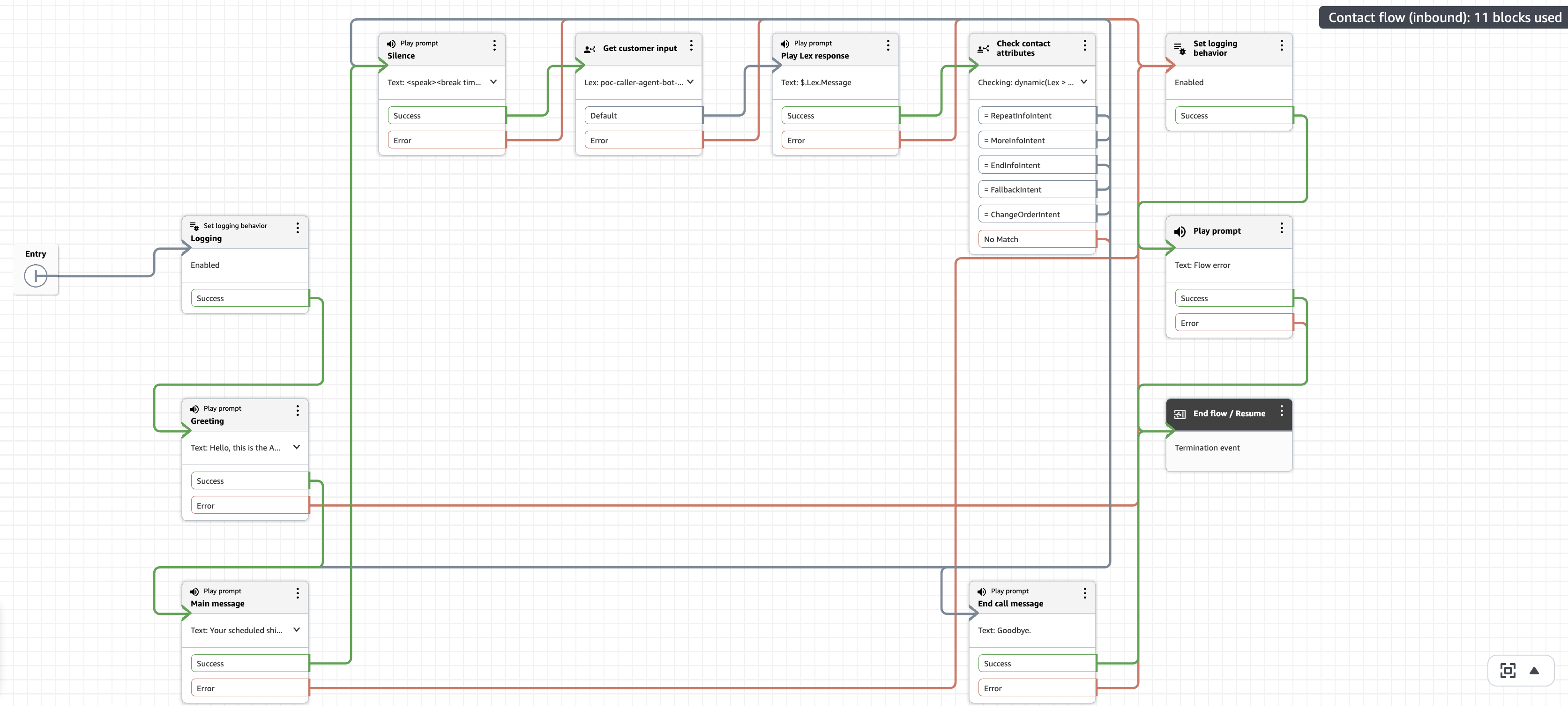
The call transitions to a Lex V2 bot after the initial summary, where recipient voice input is processed in real time. Supported intents: RepeatInfoIntent, MoreInfoIntent, ChangeOrderIntent, EndInfoIntent. The intent model was trained on natural-language variations of each response type, including fragmented sentences and common medical facility communication patterns.
Amazon Connect Flow Logic
The Connect contact flow manages intent routing, attribute-based personalization, error handling, and call termination. Contact attribute blocks carry shipment context through the call lifecycle — the Lex bot always has current shipment data available without additional API calls mid-call.
Least-Privilege AWS IAM Architecture
IAM roles and permission boundaries are scoped per service: the Lambda function that initiates calls has only StartOutboundVoiceContact permission; the Lex bot has only the permissions required to process speech input. No service has broader access than its function requires — standard least-privilege architecture for regulated data environments.
The Impact
Quantitative results demonstrating the real impact of implementation on operational efficiency, infrastructure reliability, and platform scalability
Full outbound call lifecycle automated — shipment dispatch triggers call without staff intervention
Four recipient intent types handled: repeat information, request additional details, initiate order change, end call
Natural English voice delivery via Amazon Polly neural voices — professional tone appropriate for medical facility communications
All Lex V2 intent outcomes handled within Amazon Connect flow — no fallback to manual intervention for standard interactions
Technology Stack
Built with proven enterprise-grade technologies
Interested in a similar solution?
Discuss your project→