
AI Engineering

AI features for your business workflows

Build search, recommendations and document processing into the systems your team uses. We define the data, access rules and acceptance checks before developing the feature.

Discuss your AI use case →
From the portfolio

Global Business Assistant

AI services in one operational view.

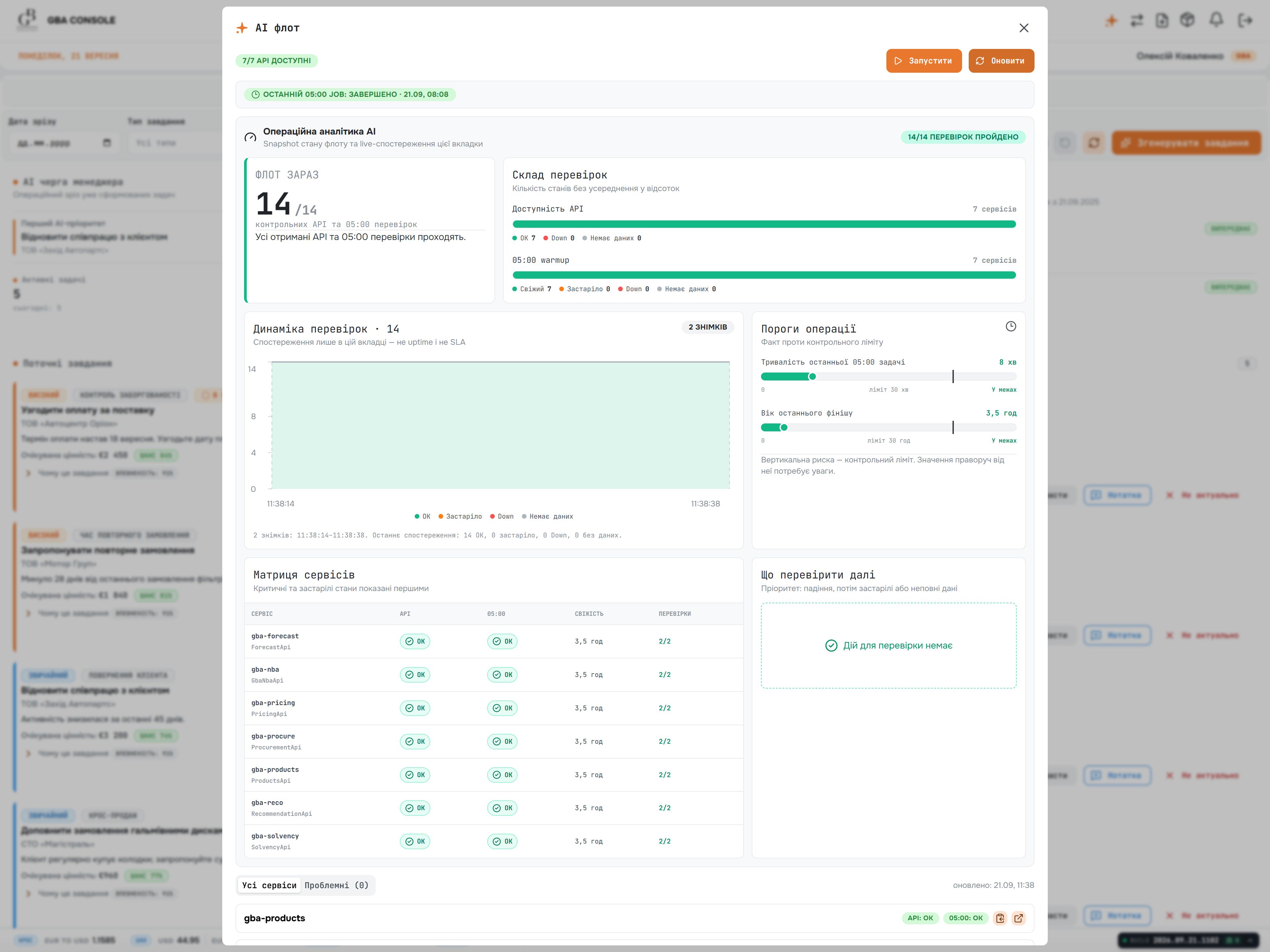
The AI fleet panel brings service availability, processing activity and data freshness into GBA. The team can see what has completed and what needs attention alongside its daily work.

  • Service availability
  • Run activity and processing time
  • Data freshness and checks
GBA AI fleet panel with processing status, run activity charts, service information and usage indicators
Global Business Assistant · AI fleet panelOpen full size
Example AI workflow

Ask a question and inspect the source

An assistant can turn a business question into a database query. We define the metric, limit the permitted data and validate the query before execution. The interface below shows the steps to review.

text-to-sql.ai
$Which products had the highest recorded order value in the EU in Q4 2025?
Question → schema → permitted query
Query to review
SELECT p.name, SUM(o.order_value) AS total
FROM products p
JOIN orders o ON p.id = o.product_id
WHERE o.region = 'EU'
  AND o.date >= '2025-10-01'
  AND o.date < '2026-01-01'
GROUP BY p.name
ORDER BY total DESC
LIMIT 3;
AI Response

Widget Pro (€2.4M), Sensor X (€1.8M), Module Z (€1.2M). Check the definition and source orders before using this answer.

data-assistant.ai

Show top 3 products by recorded order value in the EU for Q4 2025

Q4 2025 result from EU order records:

#ProductOrder value
1Widget Pro€2.4M
2Sensor X€1.8M
3Module Z€1.2M
Result·3 rows
Example interface · Demo dataAccess rules and answer checks are defined for each client system.

Text-to-SQL

Translate agreed business questions into testable database queries

Business context

Map business terms to the relevant schema and report definitions

Query validation

Validate generated queries before they run on permitted data

Security

Apply user access rules and retain a reviewable query history

Database integration

Assess the database and integration options in your environment

Architecture

How It Works

01

Natural Language

A user asks a question in everyday language.

02

Query generation

A model proposes a query using approved schema context.

03

Permitted data

A validated query runs with the user's permitted access.

04

Results with context

Results include enough context to inspect the source and definition.

Applied AI

Start with the decision, then the model

Choose a recurring task and record the time, errors or missed decisions it creates. We assess the available data and compare an AI approach with search, reporting or rules already available to your team.

01

Fragmented Data

Answers are scattered across systems and documents, with no clear source to verify.

02

Manual Analysis

People collect and reconcile records by hand before they can make a decision.

03

Generic Recommendations

Suggestions are hard to trust when the data, rule or reason is hidden.

04

Uncertain Demand

Purchasing and staffing decisions depend on estimates that are not checked against actual outcomes.

05

Ineffective Search

Staff and customers cannot reliably find the right record, document or product.

Implementation

Choose the task AI should support

Each feature needs a defined input, a useful output and a way to check the result. These are the workflows we can assess with your team.

01

E-commerce Personalisation

Suggest relevant products from catalogue and permitted customer signals. Compare recommendations with existing search and merchandising.

02

Search across approved knowledge

Use retrieval-augmented generation (RAG) to draft answers from approved documents. Retrieve only the passages the user may access and link the answer to its sources for review.

03

Demand Forecasting

Estimate demand or sales from available history. Measure error against a baseline and review where the forecast is unreliable.

04

Visual Search

Use an image to find likely catalogue matches, then let the user inspect and correct the result.

05

Inventory Optimisation

Propose reorder points from inventory, lead times and demand, with human approval for purchasing decisions.

06

Support Automation

Draft replies or classify incoming requests using approved knowledge. Route uncertain or sensitive cases to the right person.

07

Document Intelligence

Extract fields from documents for review, keep a link to the source and measure errors on representative samples.

08

Logistics Optimisation

Compare route or delivery suggestions with capacity, timing and service constraints before operational use.

Example pilot / One team, one source

Use a pilot to decide what to build next.

Start with an internal support team searching one approved policy library. Define a read-only pilot that cites accessible passages and routes unresolved questions to the responsible colleague.

Define the boundary

Name the source owner, eligible users, permitted questions and refresh schedule. Propagate permission changes and deleted content. When the available source is missing, conflicting or too old, show that limitation and send the question to a human owner.

Build a review set

A domain owner supplies representative answerable questions plus restricted, unsupported, stale and conflicting cases. Keep a separate evaluation set. Record expected supporting passages and acceptable refusal behaviour before trying the pilot.

Compare with today’s workflow

Use the same questions for current manual search and the pilot. Measure supported answers, correct refusals, permission failures, review time and cost per completed task. A fast, fluent answer still needs verifiable sources.

Agree go/no-go

Agree acceptance thresholds with the process and security owners before testing. Record answer quality, access failures and operating gaps on the evaluation set. Use those findings to approve a limited rollout, revise the pilot or stop it; resolve critical access failures before expansion.

Plan the pilot’s operating costs.

Use these example inputs to measure usage and review effort before agreeing a monthly budget.

Pilot operating cost worksheet
Cost lineExample planning inputHow to validate
Ingestion and refreshOne source, 1,000 documents, daily update checkMeasure parsing, changed documents, indexing and connector work separately.
Search and model calls20 users × 10 questions × 22 working days = 4,400 questions/monthMeasure actual calls, tokens, retries and retrieval per question; apply the selected provider’s rates.
Hosting and monitoringOne pilot environment and agreed log retentionSeparate fixed capacity from storage and usage charges; verify approved data location and access.
Human review and supportReview sample size × minutes per review, plus maintenance effortEstimate staff time for reviews, data refresh checks, incident handling and evaluation after changes.

Before launch, agree a spending limit, who receives alerts and what happens when the limit is reached. Assign responsibility for paid support and repeat the agreed evaluation when sources, prompts or models change.

Delivery approach

From a business task to a tested AI feature

Define the task, test with representative data and agree when a person must review the output.

01

Discovery

  • Identify the process owner and users
  • Choose one workflow and the decision AI should support
  • Map access rules, data quality and operational constraints
  • Agree a baseline and evaluation criteria
02

Development

  • Data pipeline construction
  • Prototype and integrate the chosen approach
  • Design source references and human review points
  • Test errors, permissions, latency and usage cost
03

Deployment

  • Production infrastructure setup
  • Agree monitoring, incident ownership and paid support
  • Review of real usage against the agreed baseline
  • An improvement plan for data, prompts and workflow
Plan an AI feature

Have a decision AI could help with?

Tell us the workflow, available data and the decision you want to improve. We will scope a practical way to test it.

Discuss your AI project